
US Dollar
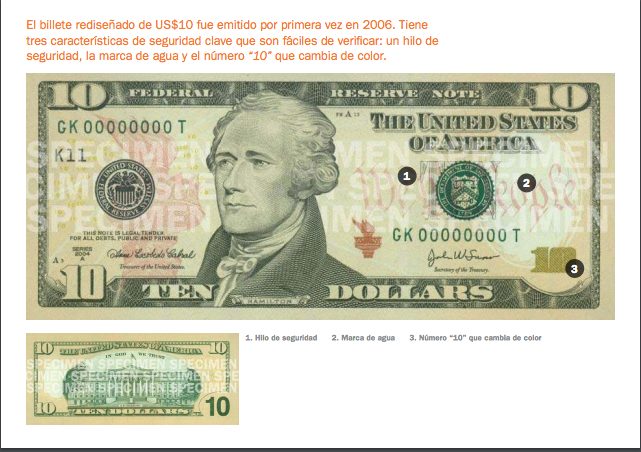
The dollar (US dollar) is the official currency of the United States of America since 1792. This currency is represented by the symbol $ and is divided into 100 hundred cents, represented by the symbol ¢. The ISO 4217 code of the US dollar is USD. United States ten-dollar bill for sale in Spain, Andalusia
The dollar is the top currency in circulation around the world. In the past, countries like Ecuador or El Salvador adopted the dollar as the national currency to combat the fluctuations of their local currencies (the sucre in Ecuador). The dollar gives such stability in countries in economic distress that savings in local currency will be converted directly to US dollars as a refuge currency not exposed to sudden devaluations.
In addition, many other countries have created their own banknotes inspired by the US dollar:
- Australian dollar
- Canadian dollar
- Hong Kong dollar
- New Zealand dollar
Origins of the American dollar
The dollar was born when on a trip to London in 1751, Benjamin Franklin asked the metropolitan parliament for permission to coin his own currency. Given the refusal of the English, it is said that Franklin bought a printing press that gave rise to the “Continentals” just before the independence from British rule.
In 1792, the Secretary of the Treasury of the George Washington government, Alexander Hamilton, inspired himself on the Spanish “real”(called by the Americans “Spanish dollar”). The “real” was at that time the most widespread currency in the world. In fact, it was the official currency in the state of Virginia.
The measure was signed on April 2, 1792 in the Coinage Act (an act establishing the creation of a mint, and regulating the Coins of the United States.) Approved by Congress, it recognizes the creation of the United States Mint Factory (the United States Mint), in charge of minting money. As for notes, the US Bureau of Engraving and Printing (BEP) is in charge of the bank notes.
At the beginning of its journey, the value of the dollar was quoted in silver. Then it changed to gold in 1944, when in the international agreements of Bretton Woods it was agreed to link the value of the currencies of the world to that of the US dollar. But as long as the Federal Reserve of the United States kept the dollar fixed in reference to the price of gold.
The gold standard went down in 1971, giving way to the current paper pattern. That is, today the dollar, like the rest of the currencies that circulate, is nothing more than a fiduciary value (currency or “fiat” money). We carriers “believe” in the support that each note we have in our pocket has, although the paper itself is worth only a few cents to produce it.
US Dollar bank notes
As we have seen before, any dollar note must be printed by the BEP (known as “Federal Reserve notes”), which has two production centers in Washington DC and in Fort Worth, Texas.
On the BEP website, you can see all the denominations currently in circulation. Today there are dollar bills with the following denominations:
- 1 dollar,
- 2 dollars (barely in circulation)
- 5 dollars
- 10 dollars
- 20 dollars
- 50 dollars, and
- 100 dollars.
There are also 2-dollar bills, but they are scarce. Also, dollar notes of denominations exceeding $ 100 are also in short supply. On July 14, 1969, the Department of the Treasury and the Federal Reserve System announced that banknotes in denominations of $ 500, $ 1,000, $ 5,000, and $ 10,000 would be discontinued immediately due to their lack of use. Although they were issued in 1969, they were last printed in 1945. United States ten-dollar bill