
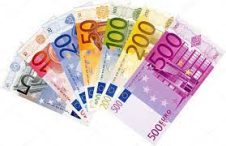
There are seven denominations of banknotes of legal tender in the euro zone: €5, €10, €20, €50, €100, €200, and €500, and their design follows the same patterns. Nowadays, two series of banknotes coexist in circulation.

Details and dimensions of banknotes
Design elements: first series
The obverse features pictures of windows and doors, symbolizing European openness and cooperation, and the twelve stars of the European Union (EU), representing dynamism and harmony among European nations.
On the reverse, there appears a bridge, representing the close cooperation and communication that exists between Europe and the rest of the world.
Other features of the design are the inclusion of the name euro, written in both Latin (EURO) and Greek (EYPO) characters; insertion of the initials of the European Central Bank (ECB) in five language variants ( BCE , ECB , EZB , EKT, and EKP ), covering the 11 official languages (in 2002) of the EU; the symbol ©, indicating copyright ( copyright ); the EU flag; and the signature of the President of the ECB. Each banknote bears the signature of either Willem F. Duisenberg, Jean-Claude Trichet, or Mario Draghi – the first, second, and third Presidents of the European Central Bank respectively. These banknotes are all equally valid.
Unlike the first series, the Europa series notes bear the signature of Mario Draghi or Christine Lagarde, president of the ECB since 2019.
New design elements: “Europa” series
The new Europa series banknotes represent an evolution. The new euro banknotes still feature the “ages and styles” design of the first series and use the same dominant colors, but have been slightly modified to accommodate the enhanced security features. This also makes them easy to distinguish from the first series.
An independent banknote designer based in Berlin, Reinhold Gerstetter, was selected to refresh the design of the euro banknotes.
The new banknotes also take into account the countries which have joined the European Union since the launch of the first series. They show:
- the name of the currency, the euro, not only in the Latin (EURO) and Greek (EYPΩ) alphabets but also in the Cyrillic (EBPO) alphabet, as a result of Bulgaria joining the European Union in 2007;
- a revised map of Europe, including Malta and Cyprus; and
- the initials of the European Central Bank in nine linguistic variants for the new €5, €10 and €20 banknotes and in ten linguistic variants for the new €50 banknotes, taking into account Croatia’s accession to the EU in 2013.
Design for visually impaired users
As with the first series of euro banknotes, visually impaired users were consulted during the design phase of the second series, and their requirements were included in the final designs.